What Are AI Agents and How Can They Automate Your Business in 2026?
If you've spent any time online in the last year, you've probably heard the term "AI Agent" thrown around — often next to bold claims about replacing entire teams. The reality is more useful, and more interesting, than the hype.
**## What Is an AI Agent, Really? ** An AI Agent is software that can understand a goal, make decisions, and take multi-step actions to complete it — without a human clicking through every single step.
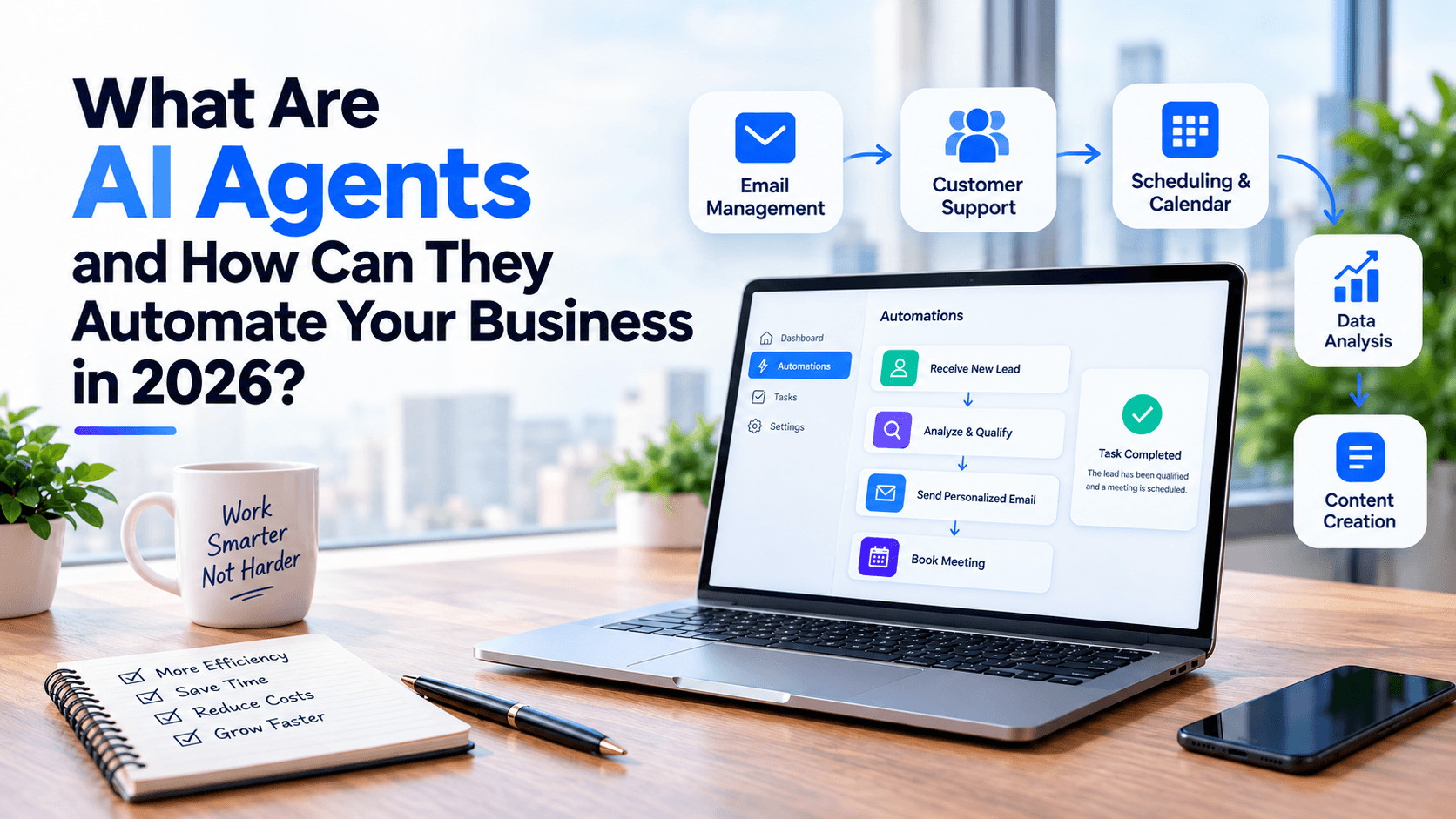
This is different from a traditional chatbot, which mostly just answers questions inside a chat window. An AI Agent can actually do things: read an email, extract the important details, update a spreadsheet, send a follow-up message, and log the result — all in one automated flow.
AI Agents vs. Traditional Automation
Traditional automation (like a basic Zapier or n8n workflow) is great at handling fixed, predictable steps: "when X happens, always do Y." It's fast and reliable, but it breaks the moment something unexpected shows up.
AI Agents add a layer of reasoning on top of that. Instead of following a rigid script, they can:
- Interpret messy, real-world input (a customer email, a voice note, a scanned form)
- Decide which action makes sense based on context
- Handle exceptions instead of failing silently
- Chain multiple tools and APIs together to finish a task
In practice, the strongest systems combine both — structured automation (n8n) for the predictable parts, and an AI Agent for the parts that need judgment.
Where Businesses Are Actually Using This
A few real, practical use cases that come up often:
Customer support triage — an agent reads incoming support tickets, categorizes them, answers the simple ones directly, and only escalates genuinely complex issues to a human.
Lead qualification — when someone fills out a contact form, an agent can research the company, check it against your ideal customer profile, and notify your sales team only when it's a strong match.
Data entry and reporting — agents that pull data from multiple sources (emails, PDFs, spreadsheets) and compile it into a clean, structured report automatically.
Content and social distribution — automatically drafting and scheduling posts whenever new content is published, instead of doing it manually every time.
Do You Actually Need One?
Not every business needs a custom AI Agent — and honestly, sometimes a simple automation workflow is the better, cheaper answer. A good way to decide:
- If the task is repetitive but always follows the exact same steps → simple automation is enough.
- If the task involves reading unstructured input, making judgment calls, or handling exceptions → that's where an AI Agent earns its cost.
Getting Started
The best starting point isn't "build one big AI system that does everything." It's picking one specific, annoying, repetitive task your team deals with every week — and automating just that.
Once it's working reliably, you expand from there.
If you're exploring AI Agents or automation for your business and want to talk through what's actually worth building, feel free to get in touch — I'd be happy to help you figure out the right approach.