The Best Roadmap for AI Engineering in 2026
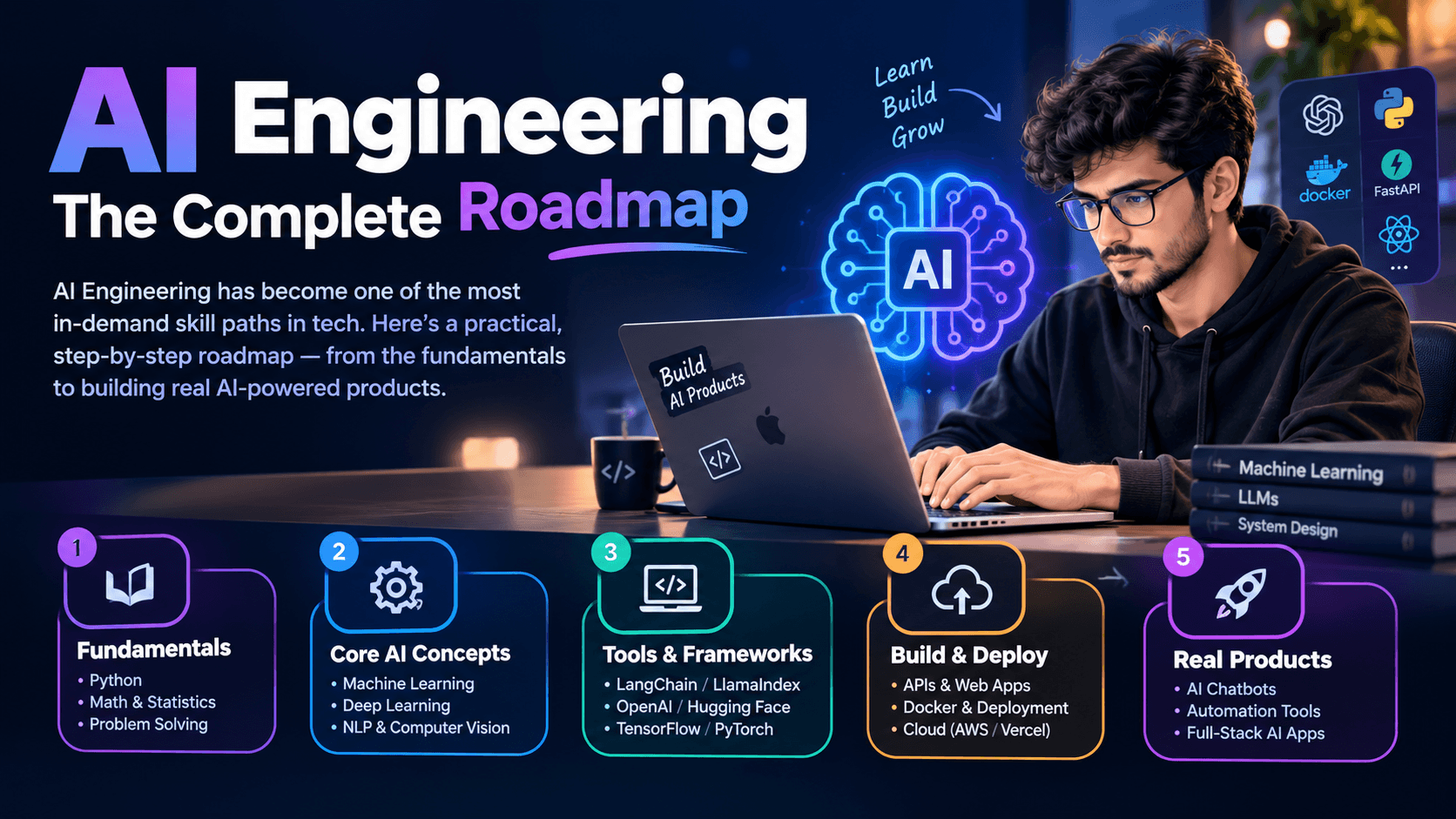
"AI Engineer" has quietly become one of the most searched job titles in tech — but it's also one of the most confusing to actually plan for. Is it the same as a data scientist? Do you need a PhD? Do you need to train models from scratch? Here's a practical, honest roadmap, based on what the role actually looks like in 2026.
What an AI Engineer Actually Does (It's Not What Most People Think)
A common misconception is that AI Engineering means training large models from scratch, the way research labs do. In practice, most AI Engineering work today is about building products on top of existing AI models — integrating LLMs, designing AI Agents, building reliable pipelines, and making AI features actually work inside real applications.
That distinction matters, because it changes the entire roadmap. You don't need a research background to become a strong AI Engineer — you need solid software engineering skills, plus a working understanding of how modern AI systems behave.
Step 1: Programming Fundamentals
This is non-negotiable, and it's the step people most often try to skip.
- Python is the standard language for AI work — libraries, frameworks, and most AI tooling are built around it.
- Learn data structures and basic algorithms — not for interviews, but because you'll need to reason about performance once you're handling real data.
- Get comfortable with APIs and HTTP — almost all AI engineering work involves calling or building APIs.
If you already have a web development background (JavaScript, Node.js, etc.), you're in a strong position — the engineering fundamentals transfer directly.
Step 2: Understand Machine Learning Basics (Not Mastery — Understanding)
You don't need to become a machine learning researcher. You need to understand:
- What a model actually is, at a conceptual level
- The difference between training and inference
- What "fine-tuning" means, and when it's actually necessary (often, it isn't)
- Basic concepts: overfitting, embeddings, tokens, context windows
This is the layer most AI Engineering roles actually operate at — understanding the system well enough to use it correctly, not building it from the ground up.
Step 3: Learn to Work With LLMs Properly
This is where most of the real, practical AI Engineering work lives today.
- Prompt engineering — not as a buzzword, but as a real skill: writing clear, structured instructions that produce reliable output
- Working with APIs from providers like OpenAI, Anthropic, and others
- Retrieval-Augmented Generation (RAG) — connecting an LLM to your own data so it can answer questions accurately instead of guessing
- Context management — understanding token limits and how to structure conversations and data efficiently
Step 4: Learn AI Agents and Automation
This is the fastest-growing part of the field right now. An AI Agent isn't just a chatbot — it's a system that can reason, make decisions, and take multi-step actions.
- Learn how agent frameworks work — breaking a goal into steps, calling tools, handling errors
- Get hands-on with automation platforms like n8n, which make it practical to combine traditional workflows with AI decision-making
- Practice building something real: an agent that reads an email, decides what to do, and takes an action — not just a demo that answers trivia questions
Step 5: Learn to Build and Ship Real AI Features
Theory only gets you so far. At this stage, focus on actually building:
- Add an AI chatbot to a real project, trained on real content
- Build a small AI Agent that automates one genuine task
- Integrate AI into an existing app — a search feature, a content generator, a support tool
- Learn to handle the unglamorous parts: rate limits, error handling, cost control, and making sure the AI doesn't say something wrong
This is usually the biggest gap between people who "know AI" and people who can actually ship AI features — the second group has dealt with the messy, practical edge cases.
Step 6: Understand the Business Side
This step gets skipped constantly, and it shouldn't. Knowing how to build AI features is only half the job — knowing when AI is actually the right solution, and when it isn't, is what separates a good AI Engineer from someone who adds AI to everything because it's trendy.
- Learn to evaluate whether a problem genuinely needs AI, or whether simpler automation solves it better
- Understand the real cost of running AI features at scale (API costs add up fast)
- Learn to explain AI capabilities and limitations clearly to non-technical stakeholders
A Realistic Learning Order
If you're starting from scratch, here's a sensible sequence:
- Solid Python and general programming fundamentals
- Machine learning concepts (conceptual understanding, not deep math)
- Working with LLM APIs and prompt engineering
- RAG and connecting AI to real data
- AI Agents and automation (n8n or similar tools)
- Building and shipping a real project end-to-end
Each stage builds on the one before it — trying to jump straight to "building AI Agents" without the programming fundamentals usually leads to copy-pasted code that breaks the moment something unexpected happens.
The Honest Truth About This Roadmap
AI Engineering isn't really a separate discipline from software engineering anymore — it's software engineering with an AI layer on top. The engineers who do this well aren't necessarily the ones who know the most about machine learning theory; they're the ones who can build reliable, well-engineered systems and know how to integrate AI into them correctly.
If you already have development experience, you're closer to being an AI Engineer than you think. The gap is usually steps 3 through 5 — hands-on experience actually working with LLMs and agents, not theory.
Exploring AI Agents or automation for your own product and want to talk through what's actually worth building? Feel free to get in touch — happy to share what's worked in real projects, not just theory.