Vercel vs Netlify vs AWS: Hosting Comparison for Modern Web Apps in 2026
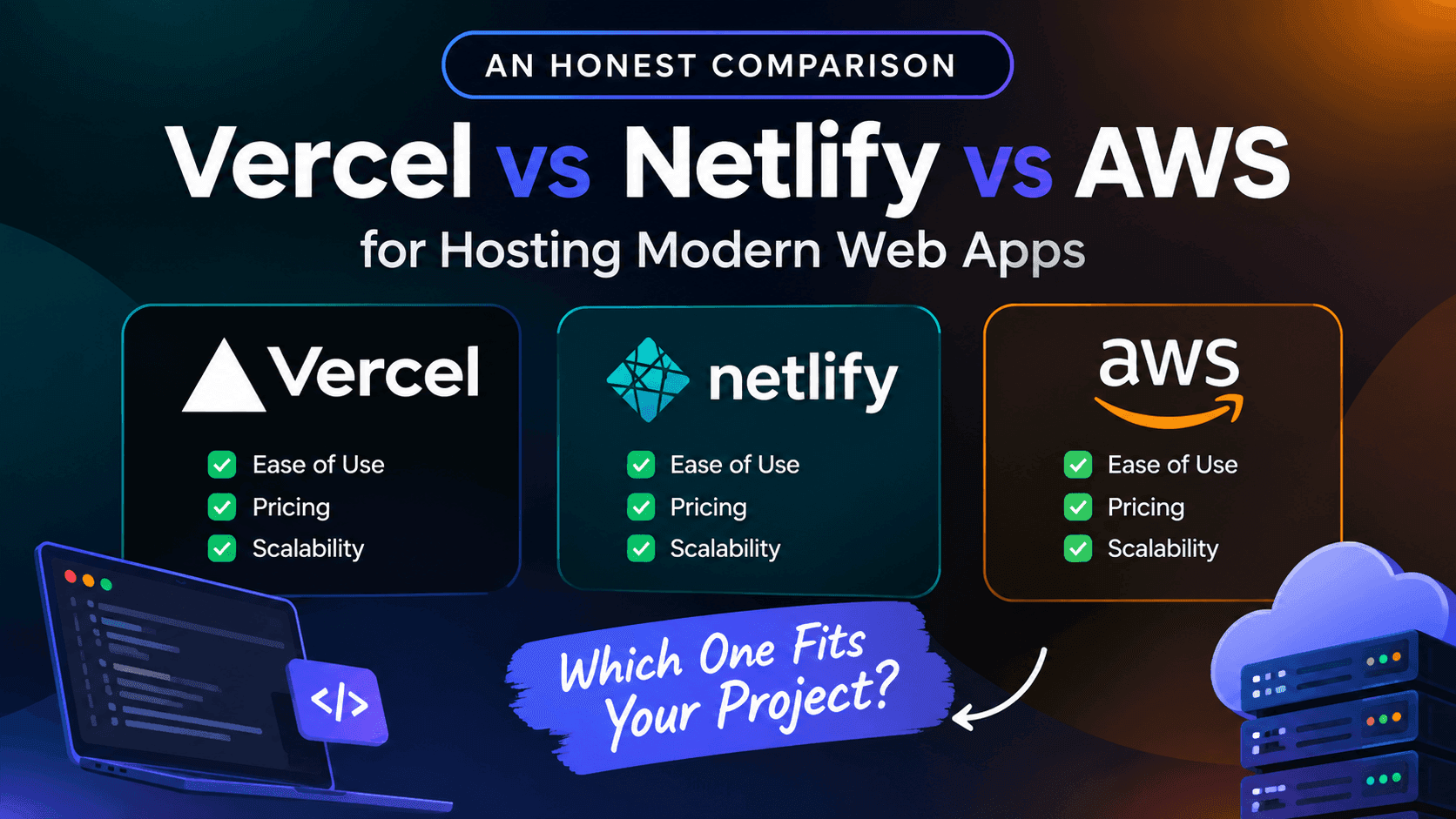
Once your app is built, you still have to decide where it actually lives. This decision gets made too quickly sometimes — "just deploy it somewhere" — but the hosting platform you choose affects cost, performance, and how much control you have as your project grows.
The Quick Answer
If you're building with Next.js and want the simplest possible deployment experience, Vercel is the natural choice — it's built by the same team behind Next.js.
If you want something similarly simple but slightly more flexible across frameworks, Netlify is a strong alternative.
If you need full control over infrastructure, or you're building something with complex backend requirements, AWS gives you that — at the cost of a steeper learning curve.
Here's the reasoning behind each.
Vercel
Vercel is built specifically around frontend frameworks, especially Next.js. Push to GitHub, and it deploys automatically — previews for every pull request, automatic HTTPS, global CDN, and image optimization built in.
Strengths:
- Zero-configuration deployments for Next.js (and most modern frontend frameworks)
- Excellent developer experience — deploy previews, instant rollbacks
- Generous free tier for personal projects and small apps
- Built-in edge functions and serverless API routes
Where it gets expensive: Bandwidth and function execution costs can add up quickly once you're past the free tier, especially for image-heavy or high-traffic sites.
Netlify
Netlify covers similar ground to Vercel — automatic deployments from Git, serverless functions, a global CDN — but with slightly more flexibility across different frameworks and build tools, not just React/Next.js.
Strengths:
- Framework-agnostic — works well with static sites, Vue, Svelte, and more
- Strong free tier and predictable pricing
- Built-in form handling, which is genuinely convenient for simple sites
Where it falls short: If you're specifically building with Next.js, Vercel usually has better first-party support since they maintain the framework itself.
AWS
AWS isn't really "hosting" in the same simple sense — it's a full cloud infrastructure platform. You're not just hosting a site; you're assembling services (EC2, S3, Lambda, CloudFront, RDS) into the exact architecture your application needs.
Strengths:
- Total control over infrastructure and architecture
- Scales to handle virtually any traffic level
- Necessary once your app needs custom backend infrastructure, complex databases, or specific compliance requirements
Where it gets hard: The learning curve is real. Configuring services correctly, managing costs, and avoiding security misconfigurations takes actual DevOps knowledge — it's not a "push to deploy" experience.
Cost Comparison, Realistically
For a small-to-medium app, Vercel or Netlify's free or low-tier plans are usually cheaper and far simpler than assembling equivalent AWS infrastructure — you're not paying for or managing servers you don't need yet.
For a large-scale application with specific infrastructure needs, AWS often becomes more cost-effective if it's architected correctly — but "correctly" is doing a lot of work in that sentence. Poorly configured AWS setups can easily cost more than a simpler platform.
Which Should You Choose?
Choose Vercel if:
- You're building with Next.js
- You want the simplest possible deployment workflow
- Your app is frontend-heavy with lightweight backend needs
Choose Netlify if:
- You're not using Next.js specifically
- You want Vercel-like simplicity across other frameworks
- Form handling and static site features matter to you
Choose AWS if:
- You need custom backend infrastructure beyond serverless functions
- You have specific compliance, security, or data residency requirements
- You have the technical resources (in-house or hired) to manage it properly
The Pattern Most Projects Follow
Many applications actually use more than one: frontend hosted on Vercel or Netlify for speed and simplicity, with specific backend services (a database, file storage, background jobs) running on AWS or another cloud provider. You don't always have to pick just one — the right setup often mixes the strengths of each.
Not sure which setup makes sense for your project? Feel free to get in touch — I can help you figure out the right hosting architecture based on what you're actually building, not just what's trendy.