Programming Languages Worth Learning And Why They Stay Relevant | Evergreen Programming Languages | Future Languages
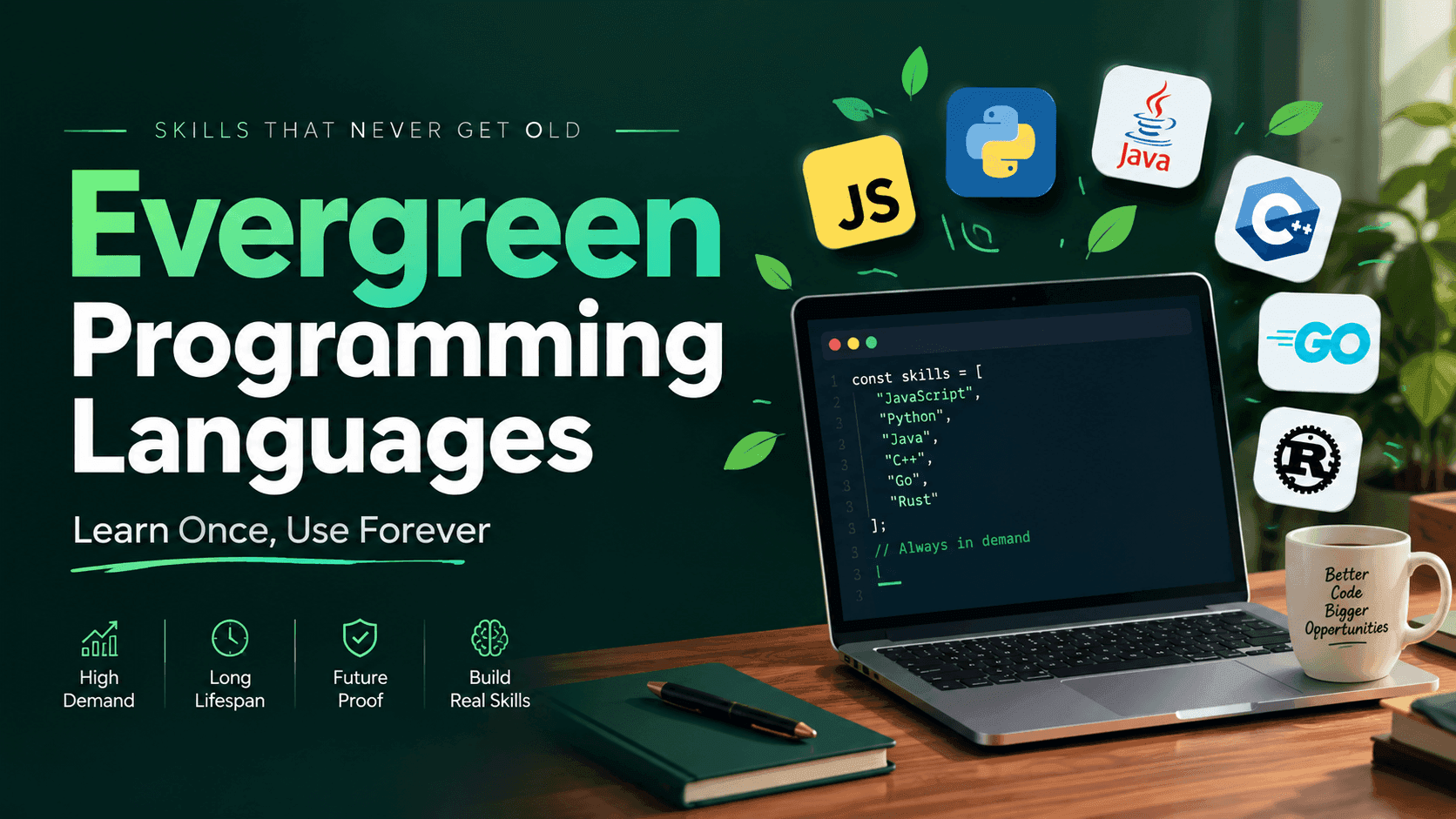
Programming Languages Worth Learning — And Why They Stay Relevant
New frameworks and languages show up every year, and it's easy to feel like you're always one step behind. But underneath the noise, a small set of languages have stayed consistently valuable for a simple reason: they solve real, common problems well, and huge ecosystems have been built around them. If you're deciding where to invest your learning time, these are the ones that keep paying off.
JavaScript / TypeScript
JavaScript runs in every browser on the planet, which makes it unavoidable for anyone building for the web. TypeScript adds a layer of type safety on top of it, catching mistakes before they reach production — which is why most serious teams now write TypeScript rather than plain JavaScript.
Why it stays relevant: The web isn't going anywhere, and JavaScript remains the only language that runs natively in every browser. With Node.js, the same language also powers backends, so one skill set covers both frontend and backend work.
Python
Python reads almost like plain English, which makes it one of the easiest languages to pick up — but it's far from just a beginner's tool. It's the backbone of most AI and machine learning work, and it's just as comfortable handling backend APIs, automation scripts, or data analysis.
Why it stays relevant: As AI and data-driven tools become part of nearly every industry, Python's dominance in that space keeps it in constant demand — and it doubles as one of the best languages for general-purpose scripting and automation.
SQL
SQL isn't flashy, and it's often overlooked because it's "just for databases." But almost every application, no matter what language it's written in, eventually needs to store and query data — and SQL is still the standard way to do that.
Why it stays relevant: Data isn't going away, and neither is the need to query it efficiently. Knowing SQL well is one of the highest-leverage skills a developer can have, because it applies no matter which other stack you're working in.
Go
Go was built for simplicity and performance, particularly for backend services that need to handle heavy traffic reliably. It's become a favorite for building APIs, cloud infrastructure tools, and microservices.
Why it stays relevant: As more systems move to the cloud and need to scale efficiently, Go's speed and simplicity make it a natural fit for backend and infrastructure work — areas that consistently need skilled developers.
Java / C#
Both are mature, strongly-typed languages that power a huge share of enterprise software — from banking systems to large-scale business applications. They're less trendy than newer languages, but the ecosystems around them are enormous and well-established.
Why it stays relevant: Large companies rely heavily on systems built in these languages, and that code needs to be maintained and extended for a long time. That steady, unglamorous demand makes both languages a safe long-term bet.
How to Choose Where to Start
Rather than trying to learn everything, it helps to pick based on the kind of work you want to do:
Building websites and web apps → JavaScript/TypeScript first, since it covers both frontend and backend. Working with AI, data, or automation → Python, given its dominant ecosystem in that space. Working with any application that stores data (which is nearly all of them) → SQL, as a supporting skill alongside whichever language you choose. Backend systems and cloud infrastructure → Go, once you're comfortable with the basics of programming. Enterprise or large-scale corporate systems → Java or C#. The Real Skill Behind the Language
None of these languages matter as much as understanding how to think like a programmer — breaking problems into smaller pieces, understanding data structures, and knowing how systems fit together. Once that foundation is solid, picking up a new language becomes far easier, because the syntax is the easy part. The languages above are worth learning not because they're trendy, but because they've proven, over and over, that they solve real problems well.