Can You Build Software Without Learning to Code? (The Honest Answer)
A few years ago, the answer to "can I build software without learning to code?" was basically no. Today it's more complicated — because the tools have genuinely gotten good. But "more possible than before" isn't the same as "possible for everything," and conflating the two leads to some expensive mistakes.
What Actually Changed
Three categories of tools made this question worth re-asking:
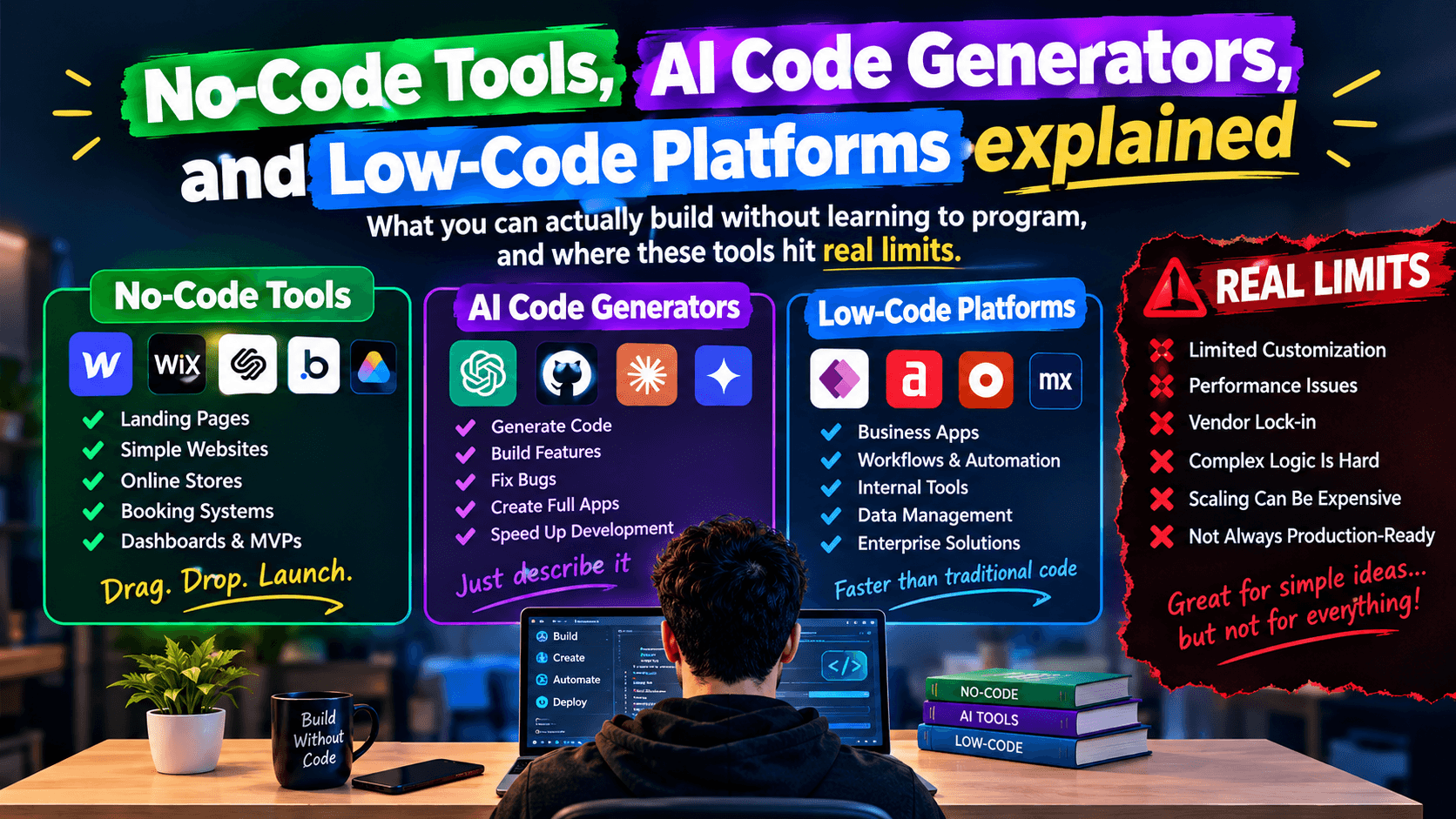
No-code / low-code platforms — tools like Webflow, Bubble, Wix, and FlutterFlow let you build real websites and even functional apps through visual interfaces, no code required.
Automation platforms — tools like Zapier and n8n let you connect apps and automate workflows without writing scripts, using a visual, drag-and-drop builder.
AI coding assistants — tools like ChatGPT, Claude, and GitHub Copilot can now write working code from a plain-language description, lowering the barrier for people without a programming background to produce something functional.
Put together, it's genuinely true that a non-developer can build more today than ever before.
What You Can Realistically Build This Way
- A marketing website or landing page
- A simple internal tool — a form that feeds into a spreadsheet, a basic approval workflow
- An MVP to validate an idea before investing in a full custom build
- Automated workflows connecting existing tools (new lead comes in → add to CRM → send a Slack notification)
- Simple prototypes to demonstrate a concept to investors or stakeholders
For these use cases, no-code and AI-assisted tools aren't just "good enough" — they're often the smarter choice. Paying for custom development on a simple landing page is usually overkill.
Where It Stops Working
This is the part that doesn't get said often enough, because it's less exciting than "anyone can build anything now."
Complex business logic. The moment your product needs genuinely custom rules — pricing that depends on multiple conditions, workflows with real branching logic, calculations specific to your business — visual builders start to strain, and AI-generated code without review starts to produce bugs that are hard to catch.
Scale. No-code platforms are often built on shared infrastructure with real limits. What works fine for 50 users can slow down or break at 5,000, and migrating off a no-code platform later is usually harder than building custom from the start.
Security. Handling payments, personal data, or user authentication properly requires real security practices. AI-generated code can look like it works while quietly having vulnerabilities that only someone who understands the underlying code would catch.
True ownership. With most no-code platforms, you don't own the underlying code — you're renting access to a system. If the platform changes its pricing, shuts down a feature, or discontinues the service, your product is affected, and you have far less control than you would with custom-built software.
Maintenance and debugging. AI tools are excellent at generating a first version. They're far less reliable at helping you debug a complex issue in a large, evolving codebase — that still takes someone who actually understands what the code is doing, not just someone who can prompt for more of it.
AI Coding Assistants Specifically
It's worth calling out AI coding tools separately, because they're the newest and most hyped part of this conversation. They genuinely help non-developers prototype faster, and they make experienced developers significantly more productive. But there's a real difference between:
- Generating code you can read, understand, and verify
- Generating code you're simply trusting works
The first is a legitimate way to build. The second is how technical debt and security issues quietly pile up — especially once the project grows beyond a simple prototype.
So, Can You Build Software Without Learning to Code?
For something simple, short-term, or low-stakes — yes, genuinely.
For something that needs to scale, handle real business logic, stay secure, or become a long-term asset you actually own — no-code and AI-generated code can get you a prototype, but not a finished, reliable product. At that point, the fastest and cheapest path is usually a developer who can take what you've learned from your prototype and build it properly.
The Practical Approach
The smartest founders I've seen don't pick one side of this. They use no-code or AI tools to validate an idea quickly and cheaply — then bring in a developer once they know the idea works and it's time to build something that can actually scale and last.
Not sure whether your project is a "build it yourself" situation or a "this needs a real developer" one? Feel free to get in touch — I'm happy to give you an honest opinion either way, even if the answer is "you don't need me yet."